

Global take on education news
Provided by AGP
Squirrel Ai Learning’s Derek Li Unveils New IEEE AI Education Standards Working Group at ASU+GSV Summit
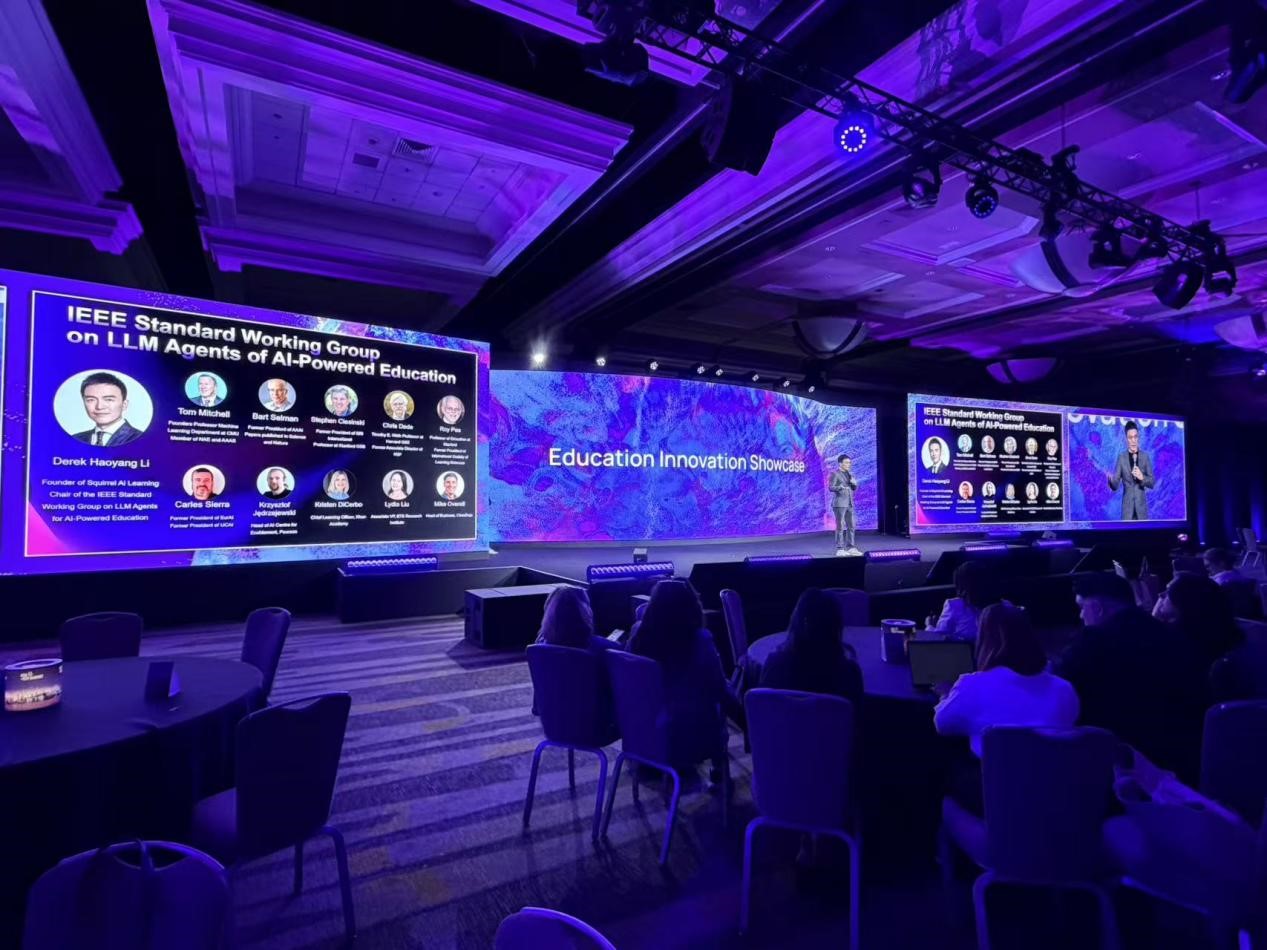

SAN DIEGO, CA, UNITED STATES, May 22, 2026 /EINPresswire.com/ -- From April 12 to 16, 2026, the ASU+GSV Summit—widely regarded as the “Davos of EdTech” and a key barometer of industry trends—opened in San Diego, California. As one of the world’s largest and most influential education technology gatherings, the summit has, for over a decade, served as a premier platform for global thought leadership, technological innovation, and industry collaboration in education.
Past speakers have included former U.S. Presidents George W. Bush and Barack Obama, former U.S. Secretary of State Condoleezza Rice, OpenAI CEO Sam Altman, and former Starbucks Chairman Howard Schultz. This year’s summit, centered on education innovation, brought together more than 10,000 participants from over 100 countries, including policymakers, leading scholars, education executives, and founders of technology companies. Discussions focused on the transformative impact of AI on education, access and equity, and the development of industry standards.
Squirrel Ai Learning Announces New IEEE AI Education Standards Working Group
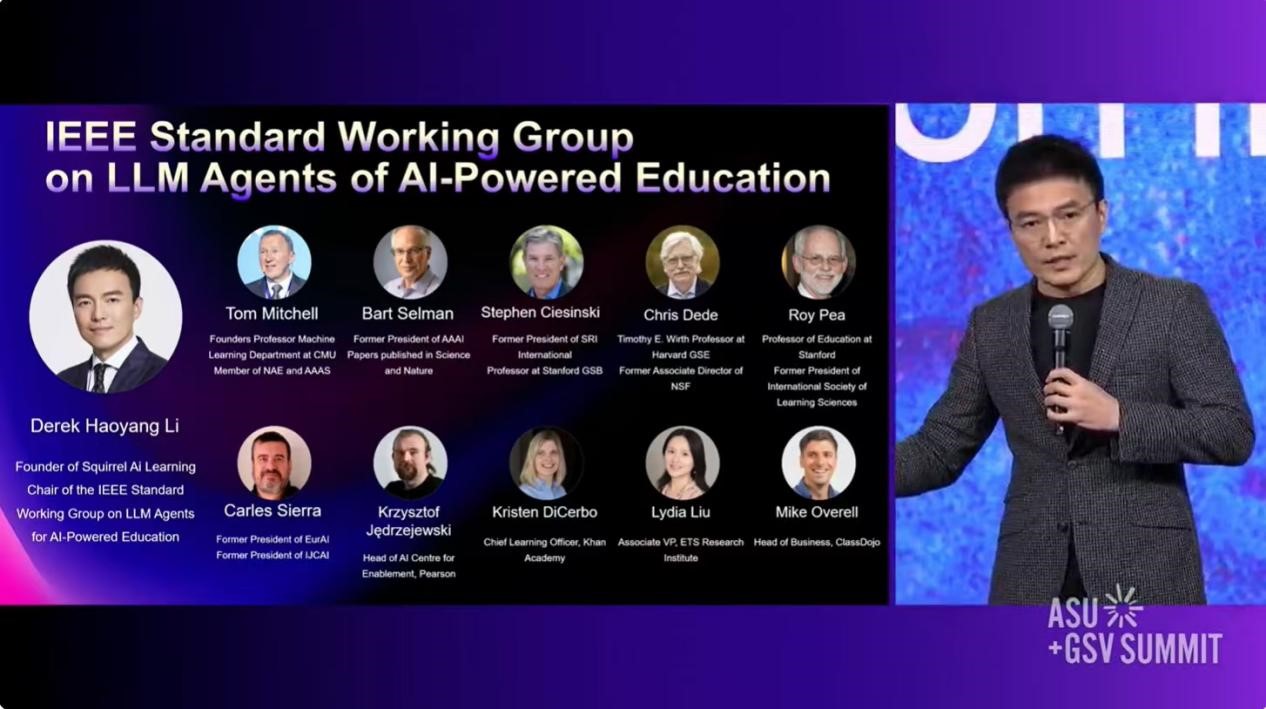
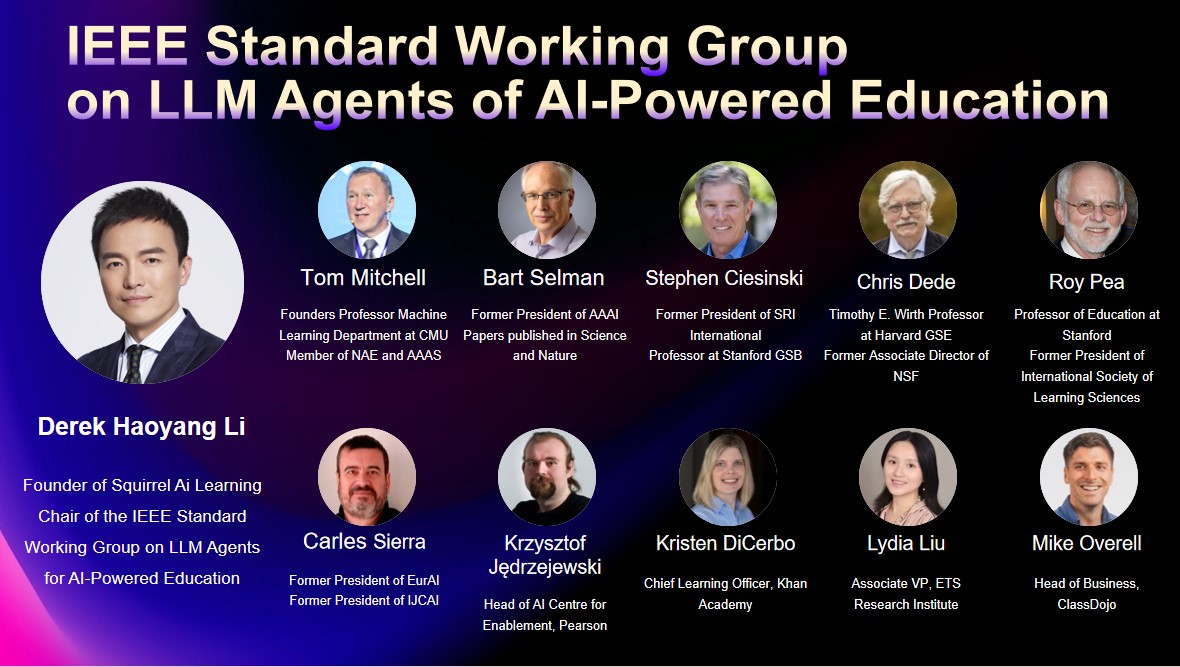
At the summit, Derek Li, Founder of Squirrel Ai Learning, officially announced the new lineup of the IEEE Working Group on AI Large Model Agents for Education, which he chairs. This marks the first time a Chinese company has taken a leading role in shaping international top-level standards for AI in education, signaling a shift from technology participation to global rule co-creation.
The working group brings together leading figures across AI and education, including Tom Mitchell (Member of the U.S. National Academies and former Dean of the School of Computer Science at Carnegie Mellon University), Bart Selman (former President of AAAI), Carles Sierra (President of the European Association for Artificial Intelligence), Chris Dede (Professor at Harvard Graduate School of Education), and Stephen Ciesinski (former President of SRI International and Professor at Stanford Graduate School of Business). It also includes senior leaders from global organizations such as Pearson, ETS, and Khan Academy.
Notably, this year’s summit featured a record number of high-profile participants, including Michael Moe (Founder and CEO of GSV), Andrew Ng (Founder of DeepLearning.AI), Omar Abbosh (CEO of Pearson), and Kristen DiCerbo (Chief Learning Officer at Khan Academy).
During a featured session, Derek Li spoke alongside Bart Selman and Curt Skotnicki of YMCA, and formally introduced the new IEEE working group—an announcement widely regarded as a milestone moment of the summit.
Technology as a Catalyst: Reimagining Educational Equity Through AI
In his remarks, Derek Li echoed a growing consensus among global leaders: AI is reshaping industries at a pace surpassing that of the Industrial Revolution. He noted that within the next two decades, AI could potentially replace a significant portion of cognitive labor, positioning education—historically slower to evolve—as one of the sectors facing the most profound transformation.
Li emphasized that the core challenge is not resisting technological disruption, but leveraging it to break down barriers to high-quality education and expand access for all learners.
Reflecting on his personal background, Li shared that his father, a nationally recognized “Master Teacher” in China, represented a level of teaching excellence that only a small fraction of students could access. Despite the significant impact such educators can have, their reach remains inherently limited. This realization inspired Li to explore how AI could replicate high-quality teaching at scale.
Founded 12 years ago, Squirrel Ai Learning has since invested heavily in R&D to develop a multimodal adaptive learning large model and its AI-powered “Intelligent Teacher.” The platform now serves over 43 million registered students and has accumulated more than 20 billion learning behavior data points. Independent studies have shown that its learning outcomes can exceed those of highly experienced educators, while reducing the cost of delivery to approximately $10 per hour—significantly improving accessibility.
In parallel with its commercial growth, Squirrel Ai Learning has provided 12 million free learning accounts to underserved communities globally, further advancing its mission of equitable education access.
Human-Centered AI: Building Global Standards and a Sustainable Ecosystem
While AI presents unprecedented opportunities for educational equity, it also introduces challenges, including uneven product quality, unclear ethical boundaries, and a lack of standardized evaluation frameworks. These issues were central to discussions at this year’s summit.
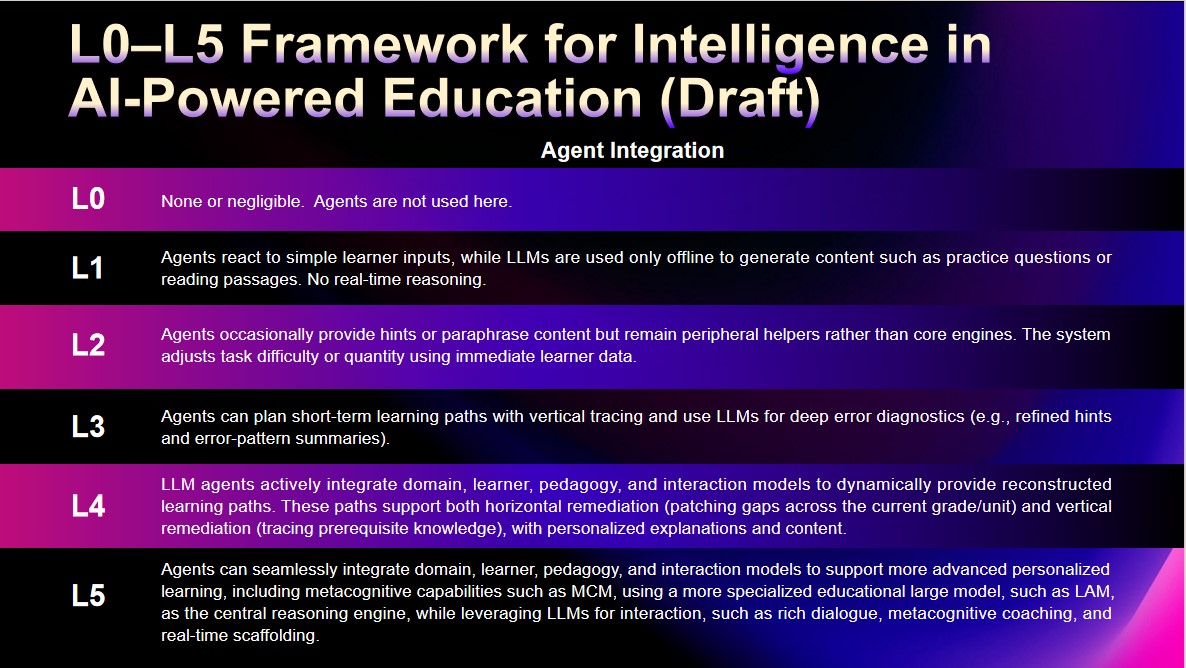
In response, the IEEE working group unveiled plans for the forthcoming “AI Education Intelligence Level Framework (L0–L5)”, the first systematic global classification standard for AI-powered educational agents. The framework defines six levels of intelligence, with L5 representing the highest level—characterized by integrated multimodal capabilities, advanced reasoning engines, metacognitive support, real-time scaffolding, and fully personalized learning pathways.
As a leading contributor to the framework, Squirrel Ai Learning’s Intelligent Teacher system has already demonstrated scalable L5-level capabilities in real-world applications, positioning it among a limited number of global pioneers in this space.
At the session, Curt Skotnicki highlighted the practical impact of deploying Squirrel Ai Learning’s technology within YMCA programs in the United States, which serve approximately 50 schools across nine districts in Los Angeles County. The collaboration aims to address longstanding challenges in community education—such as teacher shortages, scalability constraints, and high operational costs—through AI-driven solutions. A pilot program will be launched this summer to evaluate learning outcomes across after-school programs, summer courses, and camps.
Bart Selman emphasized the importance of maintaining a human-centered approach in AI education. While large language models have enabled scalable personalized learning, he noted that educators and students must remain at the core of the system. Ensuring alignment with human values and educational objectives is critical to the responsible development of AI in education—a principle that underpins the IEEE standards initiative.
From Technology Export to Global Leadership
Squirrel Ai Learning’s presence at the ASU+GSV Summit reflects a broader evolution—from delivering products and solutions internationally to actively shaping global standards and thought leadership in AI education.
With over a decade of technological development and global deployment, the company is now working alongside leading academic, industry, and educational partners to establish foundational standards for the future of AI-driven education—contributing to greater global access, quality, and sustainability in learning.
James Huang
Squirrel Ai Learning
+86 13701782210
email us here
Legal Disclaimer:
EIN Presswire provides this news content "as is" without warranty of any kind. We do not accept any responsibility or liability for the accuracy, content, images, videos, licenses, completeness, legality, or reliability of the information contained in this article. If you have any complaints or copyright issues related to this article, kindly contact the author above.
